Phaistos and the Minoan South: Palaces Without the Queues
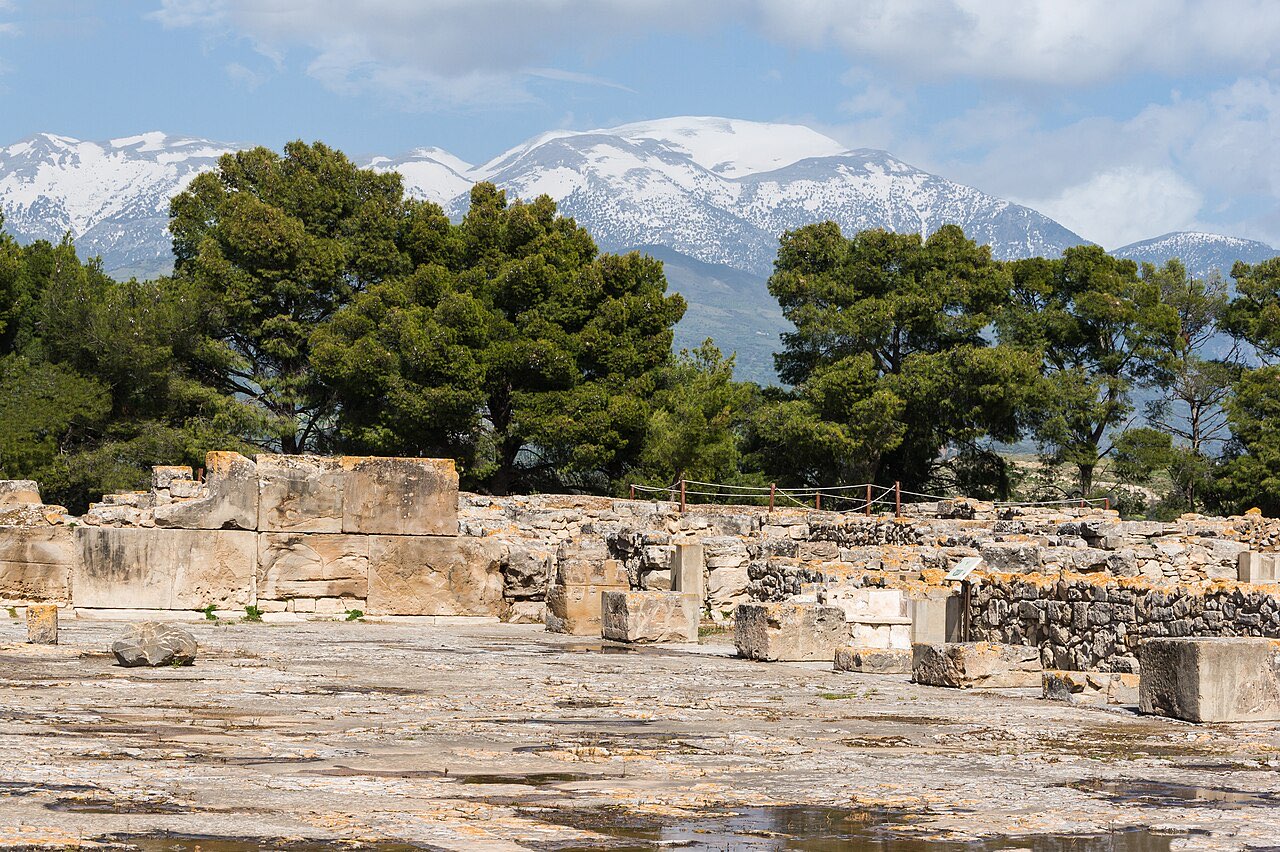
Knossos has the crowds; Phaistos has the setting. The second great Minoan palace stands on a low hill at the edge of the Messara plain in southern Crete, with Mount Psiloritis filling the northern horizon and almost nothing modern in sight. Where Arthur Evans rebuilt Knossos in concrete, the Italian archaeologists who dug Phaistos from 1900 onwards left the ruins as they found them, which means you read the palace with your imagination rather than someone else's. Many visitors quietly prefer it.
Walking the palace
The theatrical area and the Grand Staircase, twelve metres wide and cut partly from the living rock, are the showpieces, leading up to a central court aligned on the sacred peaks. The first palace went up around 1900 BC, was wrecked by earthquake, and was rebuilt on a grander plan before the general destruction that swept Minoan Crete around 1450 BC. It was in a storeroom here, in 1908, that Luigi Pernier found the Phaistos Disc, the clay disc stamped with 241 signs that nobody has convincingly deciphered in over a century. The original sits in the Heraklion Archaeological Museum, which is reason enough to pair the south with the capital; our Knossos and Heraklion guide covers that half of the story.
Agia Triada and Gortyna
Three kilometres west, the small site of Agia Triada, a royal villa or summer palace, produced some of the finest Minoan art ever found, including the carved Harvester Vase. Twenty minutes east, Gortyna shifts the timeline forward: a Greek and then Roman city, capital of the province of Crete and Cyrenaica, where the famous law code of around 450 BC survives carved into a stone wall, twelve columns of text in an archaic Doric dialect. Reading European law in its oldest surviving long inscription, under an olive tree, with cicadas for company, is the sort of thing the south does casually.
Making a day of it
The classic southern loop runs Phaistos, Gortyna and lunch, then the beach at Matala, whose sandstone caves and hippie history sit fifteen minutes from the palace and have their own tale told in our Matala guide. From the north coast it is about 75 minutes' drive each way; a transfer from Heraklion Airport towards Matala follows the same road across the island. Sites in the south keep seasonal hours and modest fees, so check locally before setting out, and carry water; shade at Phaistos is scarce and the Messara is the warmest plain in Greece.
Go in the morning light if you can, when Psiloritis still has definition and the tour buses are busy elsewhere. You may share the central court with a school group or a handful of archaeology pilgrims, and that is the crowd at its worst. The Minoan south rewards the detour precisely because so few people make it.