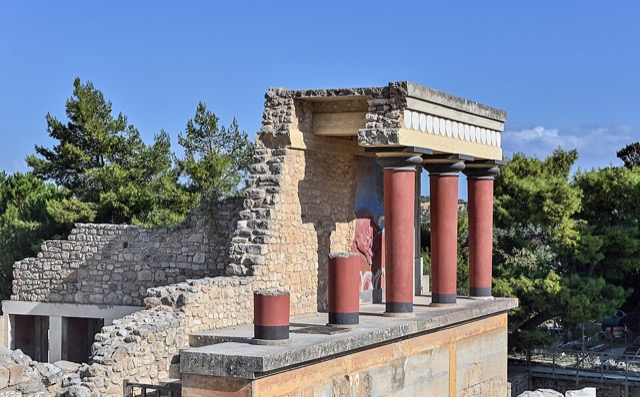
Φωτογραφία: Cayambe · CC BY-SA 4.0
← Τα καλύτερα αξιοθέατα της Κρήτης
Ηράκλειο Πόλη & Λιμάνι
Ανάκτορο Κνωσού
Minoan palace
Ancient site
Archaeological site
Family-friendly
Κλείστε μεταφορά για Ανάκτορο Κνωσού
Knossos is the largest Bronze Age archaeological site on Crete and the ceremonial and political heart of the Minoan civilization, Europe's earliest advanced culture. It sits on a low hill in the Kairatos valley just a few kilometres south of Heraklion, surrounded by what was once a sprawling town. People settled here as far back as the Neolithic period, around 7000 BC, but the site is famous for the great palace complex whose first version rose at the start of the Middle Minoan period, around 1900 BC. Destroyed and rebuilt over the centuries, the palace functioned as a hub for administration, religion, craft and the storage of agricultural wealth.
The ruins are inseparable from Greek myth. In legend this was the seat of King Minos and the home of the Labyrinth built to contain the Minotaur, a half-man, half-bull creature. The sheer scale and maze-like plan of the multi-storey complex, combined with Minoan bull imagery and the athletic ritual of bull-leaping, are often cited as a likely source of the labyrinth story. Whatever the truth of the legend, the palace reveals a remarkably sophisticated society, complete with one of the oldest known drainage and water-management systems in Europe, including clay pipes and provision for sanitation.
Much of what visitors see today reflects the work of the British archaeologist Sir Arthur Evans, who began excavating in 1900 and continued for decades. Convinced he had found the Palace of Minos, Evans carried out extensive and now controversial reconstructions in concrete, rebuilding sections of walls, columns and upper floors and reinstating copies of vivid frescoes. The result is a site that, unlike many bare Minoan ruins, gives a vivid, if partly imaginative, sense of how the painted, red-columned palace may once have looked.
A visit takes you through grand staircases, storage magazines lined with giant clay storage jars, the throne room with its alabaster seat, and reconstructed apartments decorated with reproductions of famous frescoes such as the bull-leaping scene and the dolphins. Allowing two to three hours lets you explore at a relaxed pace; a guide or audio guide helps make sense of the layered ruins and Evans's interpretations. The original frescoes and finds are housed nearby in the Heraklion Archaeological Museum, so the two pair naturally.
Knossos lies about 5 km from central Heraklion and is easy to reach by city bus, taxi or car, with tickets bought at the entrance and combined tickets available with the museum. There is little natural shade, so summer visitors should bring water, a hat and sunscreen and aim for early morning or late afternoon. It suits history lovers, families and first-time visitors to Crete who want to understand the island's deep past, though those expecting fully intact buildings should know it is a partly reconstructed ruin rather than a standing palace.
Πρόσβαση
Knossos is about 5 km south of Heraklion and is easily reached by frequent city bus, taxi or car, with parking and ticket booths at the entrance.